A Digital Memorial · Established MMXXVI
AugustusPitt-Rivers
Soldier of the Grenadier Guards. Ethnologist. The first scientific excavator in Britain. Founder of the museum that bears his name.
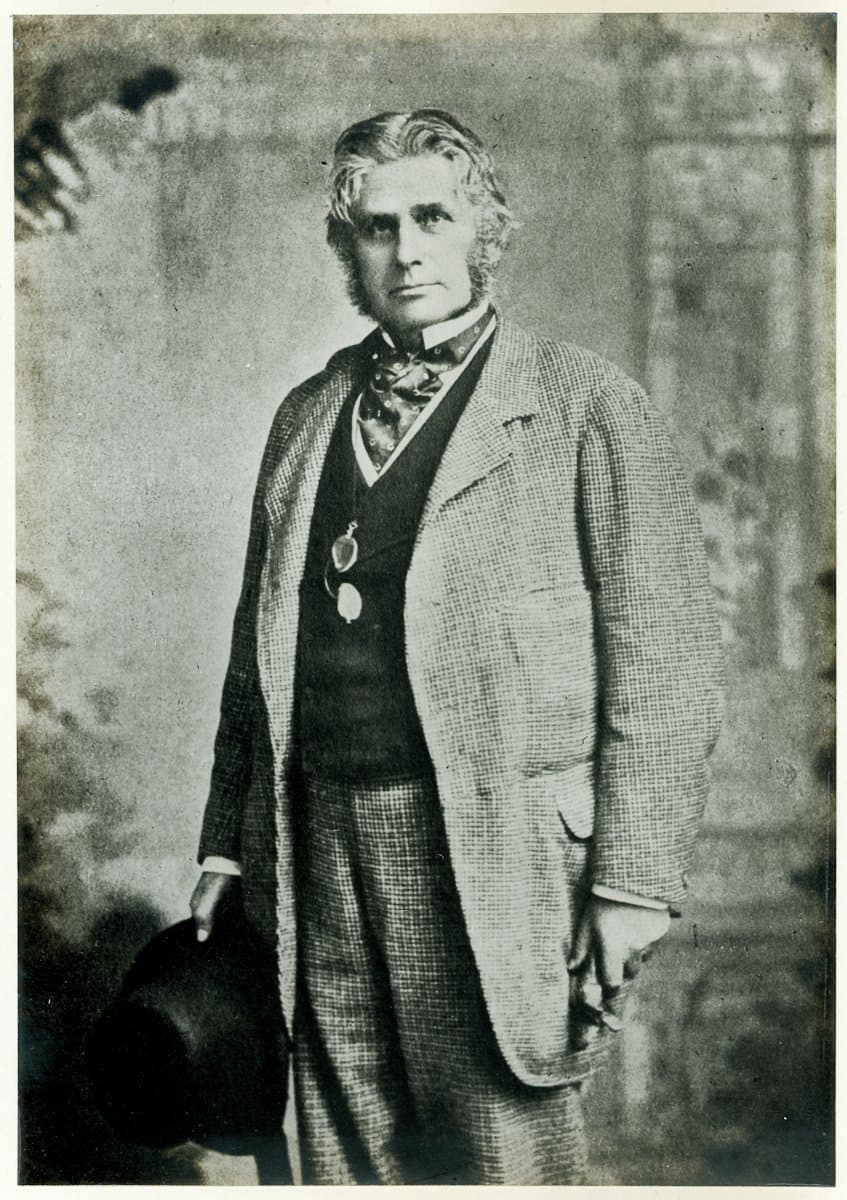
Born
14 April 1827, Hope Hall, Yorkshire
Died
4 May 1900, Rushmore, Dorset
Trade
Soldier · Ethnologist · Archaeologist
Legacy
The Pitt Rivers Museum, Oxford
“When the dates cannot be given, then recourse must be had to the sequence of type — and that is what I term Typology.”
A. H. L.-F. Pitt-Rivers, Typological Museums, 1891
An introduction
Who he was, and why his name matters still.
Augustus Henry Lane-Fox Pitt-Rivers was a man formed by two disciplines at once: the army and the museum. Forty years as a Grenadier Guards officer taught him to watch a mechanism, the rifle, improve by small and patient steps. That habit of mind became a theory of culture. He came to believe that human inventions evolve exactly as Darwin had shown species evolve, with form succeeding form in gradual sequence and the simple growing into the complex.
When in 1880 he inherited one of the largest estates in Britain, he spent its wealth on his grand experiment: twenty years of excavations across his own land at Cranborne Chase, conducted with a rigour no one in Britain had yet attempted, and published in four magnificent volumes that remain models of the discipline. And at Oxford, the museum he founded still stands, its crowded Victorian galleries arranged exactly as he demanded, by type, in the sequence of ideas.
“Excavators, as a rule, record only those things which appear to them important at the time, but fresh problems in Archaeology and Anthropology are constantly arising... the points which would have been most valuable have been passed over from being thought uninteresting at the time. Every detail should, therefore, be recorded, in the manner most conducive to facility of reference, and it ought at all times to be the chief object of an excavator to reduce his own personal equation to a minimum.”
“Having retired from active service on account of ill-health, and being incapable of strong physical exercise, I determined to devote the remaining portion of my life chiefly to an examination of the antiquities on my own property.”
Index of the archive
The whole of the record, in nine plates.
The Life
Birth, marriage, inheritance, death. The biography entire.
Open the plate →Pl. 02The Soldier
Forty years in the Grenadier Guards, and the rifle that made his theory.
Open the plate →Pl. 03The Excavations
Cranborne Chase, Wor Barrow, and the invention of scientific digging.
Open the plate →Pl. 04The Museums
The founding gift to Oxford, and the typological principle in glass.
Open the plate →Pl. 05The Theory
Typology, the evolution of culture, and the mind of the collector.
Open the plate →Pl. 06The Collections
The objects: the Star House Pole, Benin, and the guns.
Open the plate →Pl. 07The Writings
The books and papers that set the discipline's course.
Open the plate →Pl. 08The Family
Alice and the children; the dynasty that followed.
Open the plate →Pl. 09The Legacy
What survives: the science, the museum, and the reckoning.
Open the plate →